

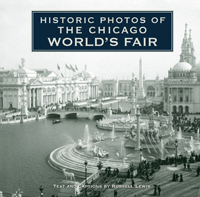
Chicago’s 1893 Columbian World’s Fair, or the World’s Columbian Exposition, was known popularly as Chicago World’s Fair introduced Chicago and the world to the 20th century.
It was the first event of its kind to have a publicity department, and an organized promotional campaign that included two official photographers who were licensed to produce images. Photography by the public was limited and cost $2 a day.
Electric lighting was still novel on a large scale, but was featured throughout the White City and the rest of the Fair. Even State Street was draped with electric lights to promote the Columbia Exposition, as the fair was called.
My grand-parents’ parents met at the World’s Fair, as did my husband’s grand-parents’ parents. For these and many other young immigrants in Chicago in the 1890s, women found work “in service” as ladies, maids or nannies, and men were journeymen, tradesmen, chauffeurs or manual laborers. The World’s Fair was an escape from life’s drudgeries. For less than one dollar a day, you could enter the White City, stroll along the Midway and spend the day in what must have seemed like a dream of a distant future.
The photos in this book chronicle the wonder that was the Columbian Exposition, which was built on the shore of Lake Michigan, rose to shine brightly and literally, with an unprecedented display of electric lighting, and then burst into flames to disappear into the collective memories of Chicagoans and the world.
Russell Lewis’ access to the most extensive collection of photographs of the 1893 World’s Fair held by the Chicago History Museum where he is chief historian, allowed him to go seek out images that weren’t part of the fair’s official promotion. These images are not available online, and the images by Arnold, the official fair photographer, are available only from other libraries and archives. Only a single structure from the 1893 World’s Fair, the Museum of Science and Industry, survived into the 21st century. Typically, we see photos of the fair’s lost buildings, most of which burned down in a series of fires between 1893 and 1894.
Lewis chooses a different set of photos that put the fair into a geographic context. Through photos of the “intramural elevated railway” and the electric shuttle trains that moved attendees from the 63rd St. pier, where many arrived by the ferry from downtown, to the fair grounds, we can map the World’s Fair onto the Chicago of the 21st century. The origins of public transportation are evident in photos of the the South Side Rapid Transit, the first elevated line put in operation, built and put into operation to take people from the Loop to the fair. It was originally pulled by small steam locomotive and it was electrified in the late 1890s. The intramural was built for the fair. There are several photos that allow the viewer to see the fair in relation to Hyde Park and downtown.
The photos have been cropped, and some have been cleaned up, but the prints have not been otherwise digitally altered. The captions are informative, but not exhaustive. This makes the book accessible to someone who is new to the World’s Fair, as well as making it a quick reference for those who are interested in architecture or history. The chapter called “Building the White City” makes Historic Photos of the Chicago World’s Fair a visual companion piece for the exhaustive information about the construction and site preparation in “Devil in the White City.”
The Chicago History Museum has a set of the official images as well as professional images by a number of prominent photographers of the day. If you have any photos of the fair taken by amateurs, the staff would love for you to click on “About the Collection” and then click on “Artifact Donation.” Scroll down to “How to donate artifacts and documents” and fill out the online donation form. Attach a copy of the photograph for the curatorial staff to review.
The book can be purchased from Amazon.com or from Turner Publishing.
Related articles by Zemanta
- World’s Fair Flashback (chicagoist.com)
- Louis Sullivan’s Idea at the CCC (chicagoist.com)
