

According to the college website, Columbia College Chicago is the most diverse private arts and media school in the country.
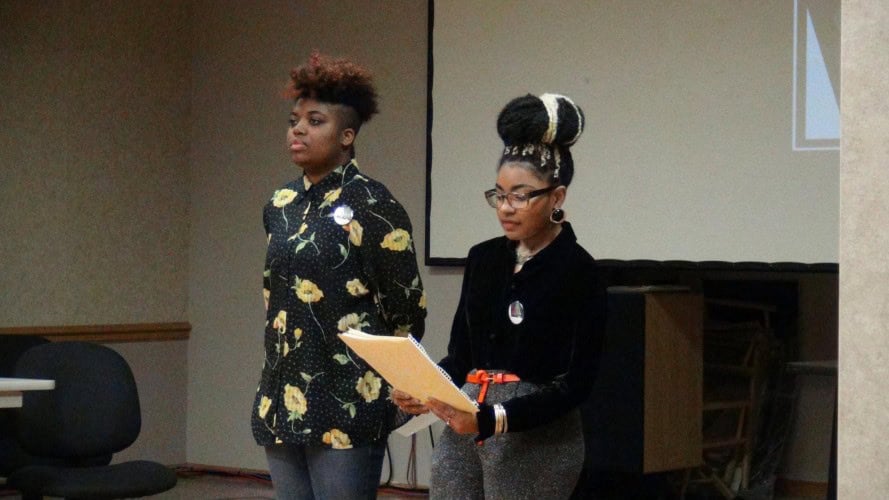
The Black Film Society created the first African-Diaspora documentary entitled “The Black Sheep Roundtable” which takes a pointed look at how much support black filmmakers receive from faculty in the Film Department.
The Black Film Society, a student organization whose goals are to build a community of inspired artists that collectively engage in cinematic activities through viewing motion pictures and critical discussions on techniques and themes.
“A lot of us are struggling to make our voices heard as individuals,” said Marcus Martin, co-founder and former president of the Black Film Society. “So, we came up with a creative way to make sure that our voices were heard. ”
Martin claims the only time he has seen more than one or two black people on a set, is when a director or producer chose them for the lead role.
Jennifer Peepas, a professor of Cinema Arts and Science, said she believes the Film Department can do more to support and help students produce films that depict the black culture.

“Students of color are saying that they’re not seeing their experiences in themselves represented on screen,” Peepas said. “It’s absolutely true when you look at films we screen today.”
Senior Jade Ivy, who is a Directing Concentration major, said the movie “Do the Right Thing,” is known as the “Black Movie” to show. But she says it is not the only black movie that should be viewed in class.
Ivy explained that in her Black Independent Cinema class, she saw many films that she had never come across before, like “Nothing but a Man.”
“This movie is supposed to be the best black Independent film of today,” Ivy said. “I’ve been at Columbia for three years now but I’ve never heard of this film until 2013.”
Ivy said this movement isn’t just for blacks being able to be recognized and heard but it does feel good to see someone like you in a higher position.
“It’s not just a black thing,” Ivy said. “It’s about everyone having a voice.”
Ivy said when you have black professors in classrooms it creates power for the black students because they can connect with someone like them on a professional level.
“I know if I saw more professors of my face in a position of power, it would give me the confidence to know that I can become that too,” Ivy said.
Vaun Monroe, an adviser for the Black Film Society and professor of Cinema Arts and Sciences, is one of the only two black professors in the Film Department.
“It’s lonely but it’s my reality,” Monroe said. “What I would ask other faculty is ‘What would it be like for you to go to work every day and deal with people who are not like you and who have no understanding of your culture and where you come from’.”
Martin said he believes the history of race is complex and the separation of people by color and makes it difficult for whites to fully understand blacks whose lives are often delineated by the color line.
“A white person can never feel what a black person feels because they’ve never been black before,” Martin says “Columbia is officially segregated.”
Former MFA student Linda Garcia Merchant said, in order for this change to come, Columbia must help build the bones of the body of work.
“We need the actual structure; we have the meat but we need the bones,” Merchant said. “We need the physical structure to make the body stand up.”
Peepas said that she believes Columbia can start the change by recruiting more minority faculty.
“I think we should do better in recruiting black faculty for full-time positions,” Peepas said. “Sometimes we underestimate how important it is for students to have someone in the class that they can relate to.”
Merchant said students who want to be heard must take a stand and not hold back.
“Fight for it,” Merchant said. “Every student needs a voice and should have a voice. Everyone who pays to come to this school should have the same voice in a classroom.”
Merchant said Columbia should be fair to every artist that is apart of their school, and students shouldn’t have to do double the work to get this education.
“Right now we don’t need challenges about culture,” Merchant said. “We need answers about process.”
