
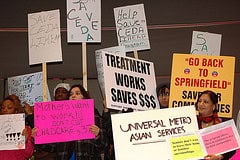


The $150 Jacqueline Platania receives twice a year to help offset her electricity bill is at risk of getting reduced in the future due to state budget cuts.
Her Lincoln Park apartment is government funded, she said, and living off Social Security is not easy.
The Low Income Home Energy Assistance Program, known as LIHEAP, has helped her over the past 15 years.
ComEd accepts Platania’s LIHEAP payment, leaving her to pay only a small portion of the bill. If she didn’t have the help, she said living would be rough, especially during the summer months.
“It would put me in a hardship because I get mine right in the summer when you run the air conditioner, and that’s high,” she said. “I look forward to getting that [deduction] off my electric bill,“ she said.
Platania is not alone.
According to a 2011 report by the Low Income Home and Energy Assistance Program, Illinois LIHEAP provided 460,146 households with financial assistance that year.
There are almost 1.5 million eligible households in the state, most living at least 150 percent under the poverty line. The government funded program helps offset utility bills for heat and electricity.
In past years, national funding for LIHEAP estimated close to $5 billion, but it keeps getting reduced.
In Illinois, it was $185.7 million last year. In 2011 it was $248.9 million.
“It appears there is going to be a reduction to the LIHEAP funding, about 5 percent, which is significant because we’ve already been experiencing reduction in the last couple of years,” said Brandon Avila, spokesman for a Washington-based advocacy group called the Low Income Home and Energy Assistance Program, Campaign for Home Energy Assistance.
That 5 percent may seem small to some, but this percentage means between 12,000 and 15,000 households in Illinois will not get energy assistance, said Larry Dawson, chairman for the National Energy Assistance Directors Association.
The last “large” national increase the program received was $4.5 billion in 2010. Illinois was allocated $265.8 million three years ago, much more than this year’s $148.4 million. This fiscal year, the state lost $8.6 million to fund its LIHEAP program and weatherization program, which are both equally important, said Dawson.
The U.S. Department of Health and Human Services provides funding for LIHEAP, said Dawson, who also said it authorizes the state’s board of directors to transfer up to 15 percent of LIHEAP funding to the weatherization program, which does home audits. This can provide a home with long-term energy efficiency savings.
“It’s a tough budget year, and I don’t expect it to get any better,” said Avila.
His organization lobbies for more funding for who it calls the most “vulnerable,” which are the elderly, disabled and children under 5-years-old.
“We would contend that programs like LIHEAP are basically the safety-net for the poorest of the poor, and it shouldn’t be lumped in with some of the other grant programs that aren’t necessarily dedicated to the most vulnerable population,” he said.
Illinois funds 25 percent of energy-efficiency programs in the state, and provides some funding to low-income assistance programs, and utility companies assist with the remaining 75 percent, said Kayce Ataiyero, spokeswoman for the Illinois Department of Commerce and Economic Opportunity in an email.
Even though financial assistance for families has decreased, funding for energy efficiency programs around natural gas and electricity have increased, she said.
“Funding energy efficiency programs is extremely important, not only to protecting our environment but to creating much needed green jobs. For every $92,000 spent on energy efficiency, a job is created along the supply chain,” said Ataiyero.
