
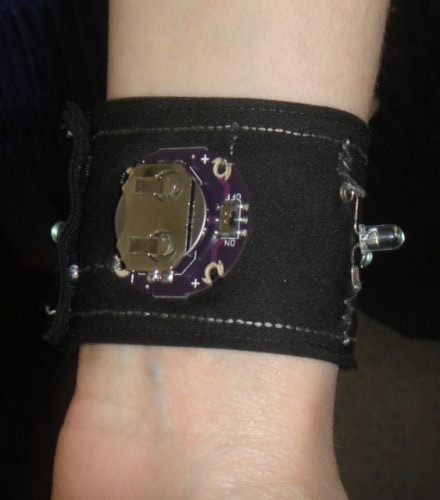

When you open the door of the Pumping Station 1 (PS1) at 3915 N. Elston you enter one of Chicago’s hackerspaces. Anything might be going on there, but on a recent Saturday, the work tables on the 2nd floor were shoulder to shoulder with members of Chicago Women Developers on hand for a session called “eTextiles using Arduino.”
Arduino, adafruit, and lilypad LED are notions you wouldn’t find in grandma’s sewing box, but for the women hackers at PS1, laptops, micro processors, computer programs, and conductive thread fit right in with felting, feathers, and fun. For many of the workshop participants, being the “other” and the “only one” in the workplace, as women coders, software engineers, and programmers has been solitary and tiresome.
The Chicago Women Developers Meetup Group (CWD) grew out that idea, according to its founder, Melissa Pierce. Pierce is a woman of many interests, who puts together CWD workshops for the more than 600 “codettes” who have joined the CWD Meetup. They meet to talk hacking, programming, and on February 2nd, eTextiles and arduino (Note there is a March workshop scheduled.) Pierce said the projects were interesting, but it was just fun to be with other women programmers and engineers, and to be with people you could talk to about work and the challenges of being the only”, or one of only a few women at any particular company.
Arduino is a bit confusing because it refers to a programming language and a processor. The arduino devices like the Flora and Lilypad LED, can be programmed, but they too small to have an input device. To program an arduino device, find or write a program after you download a version of Arduino to a laptop, connect the flora or other device to the laptop with a USB cord, and download the program to a device, also referred to as an arduino.
Downloading Arduino to your laptop, and locating pre-existing programs from a site like adafruit will get you started. The arduino devices are connected to a coin-size batteries via conductive thread.
At the seesion, Molly Rossow from Northwestern Research Lab who is a knitter, was working with the conductive thread and a couple of floras to make a small fabric cat. Her aim was to use the arduino device to make the cat “meow” when it was connected to its battery. By the end of the workshop, the cat’s were meowing on cue.
Ibis Mestey chatted while she was downloading drivers for the floras she was working on, and noted that adafruit is a woman-run company that provides instructions, video tutorials, and arduino devices like the Lilypad LED and the flora for eTextile projects.
Marcos Alcozer, a man among the women, is the technology co-ordinator at Northside College Prep High School in Chicago. Maros sewed his flora to a piece of cloth that was held in an embroidery hoop, and was getting ready to test his program on the arduino. He plans to introduce the arduino devices in a club at the school, and then teach and use them in a course where students will build an interactive wall at Northside Prep.
Radna Gummluri was learning how to use conductive thread and the LED lights so she could help mother, a fabric artist from India, to create work with eTextiles. She had a the adafruit program on her laptop, and by connecting the Flora device via USB cable, she uploaded a program to make the lights blink. Radna said she absolutely loved being other women programmers and showed pictures from her phone of her mother’s fabric art projects.
Sheila Miguez is a member of CWD and a member of Pumping Station 1. She said that PS1 was an ideal site for the CWD e-textiles workshop because it had tables, plenty of outlets, and space for the women to set up for the projects.
Angeleah Daidone acknowledged that the various projects were more about learning and understanding arduino and arduino devices thanthey were about being function items of clothing. She noted that Chicago’s Everpurse, a small stylish purse that charges a phone is an example of how tech and fashion can be integrated to provide something useful that is beautiful too.
ABC must have heard about this interesting group, and they’ve got a piece about women hacking at CWD
