
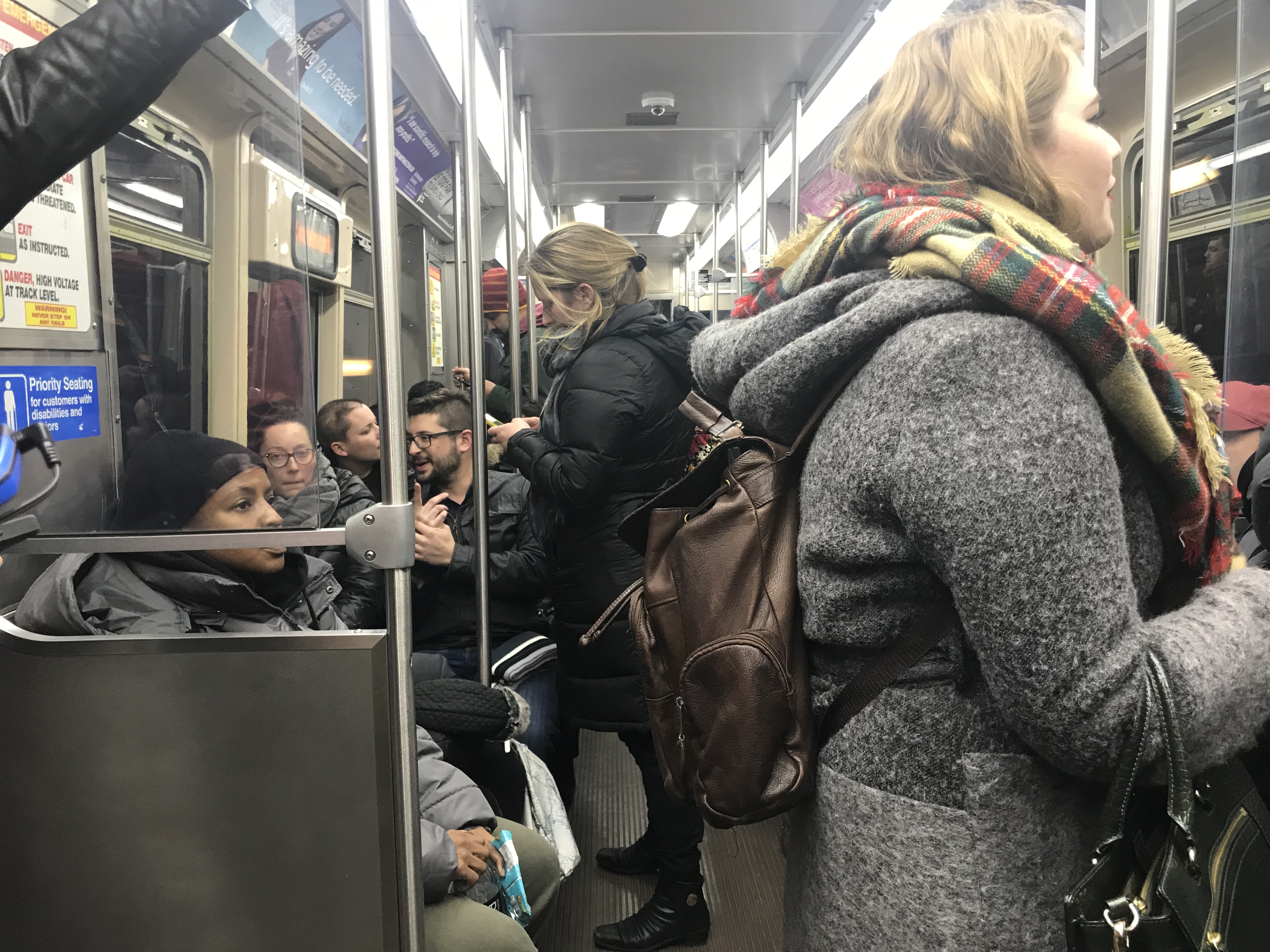

On a cold morning this past January, Columbia College Chicago student Caroline Pejcinovic took a bus from her apartment in Logan Square to the California Blue Line stop to make it downtown in time for work. Unfortunately, this put her in the midst of the 8:30 a.m. rush.
She said she started to feel ill on the platform but decided to get on a train anyway. Everyone around her was bundled up in hats and coats, and she at first attributed her sweating to the warmth of the packed train. She passed out just before her train pulled into the Clark and Lake station.
“It was just really crowded,” said Pejcinovic, whose fainting spell due to flu symptoms was aggravated by the crowded conditions on the train. “I didn’t even hit the ground.”
Pejcinovic’s experience is not a unique one. It illustrates a growing problem of overcrowding on the CTA Blue Line, especially in the Logan Square area.
According to CTA, the annual number of rides on the Blue Line O’Hare branch has increased by 5.4 million between 2006 and 2016. All of the stations between Belmont and Damen were among the top ten that saw the largest increase in riders during the morning peak period.
As for what has caused this increase in ridership, some point to the number of housing developments that have gone up along Milwaukee Avenue in Logan Square in recent years.
“The main driver of increased ridership is the continued growth of communities along the branch, including some transit-oriented developments,” CTA media representative, Irene Ferradaz, said in an email interview.
Jerry Mandujano, an aide to Ald. Joe Moreno (1st), said it’s hard to pinpoint a causation for the increase.
“I wouldn’t be surprised if transport-oriented developments — with less parking space, discouraging car ownership — bring residents to the train,” he said. “But I think those residents were coming in already.”
Mandujano also said he has seen Logan Square turning into a trendy area in recent years.
“Rents are rising a little bit, and maybe people who can afford those rents and work downtown want to take transit more often.”
Having identified a reason for the overcrowding, several possible solutions present themselves.
“If people could drive and park downtown, maybe that would eliminate the overcrowding problem,” Pejcinovic said. “But, then again, that creates another problem on its own.”
While increased car traffic to the Loop may only add to congestion, Mandujano said looking at the problem from the point of view of downtown could provide a resolution.
If downtown employers stagger the times of their employees’ work days, it could shrink crowds and more effectively use the resources the city already has, Mandujano said.
“The problem isn’t that the [Blue Line] can’t service the amount of people living in Logan Square,” Mandujano said. “The problem is everyone goes at once and it floods the system.”
Another regular Blue Line commuter, Patricia Ramos, who lives in Logan Square but works in River North, said many big delays stem from small causes.
“An issue that I normally seem to run into is a door not operating correctly somewhere,” she said. “And then that causes delays. A small thing like that can affect it extremely.”
Ramos, who will sometimes have to wait for two or three trains to pass before she can find an open spot, said she would like to see trains operating more frequently during rush periods.
That seemingly simple fix proves much more complicated.
“The [O’Hare] branch was opened in 1984, and was built with power and signals that would accommodate projected growth at the time,” Ferradaz said. “But that growth has outpaced those initial projections, and we’re currently running as many trains as the current power and signal systems allow during the morning rush.”
Ferradaz said that Your New Blue, the CTA’s comprehensive program to improve capacity on the Blue Line, includes a $42.9 million project to upgrade two of the electrical substations that service the O’Hare branch. The partially federally-funded project, started in 2017 and slated for completion in 2020, “will help improve service reliability along portions of the Blue Line,” she said.
FastTracks, a CTA program announced in February, includes a $25 million project that will add a substation to the line, providing power enough to support additional trains.
But the scope of these programs are only so large, said Julia Gerasimenko, the advocacy manager for the Active Transportation Alliance, an organization that promotes the sustainability of walking, biking, and public transportation.
“To really meet the increased demand, I think elected officials of all levels of government need to be on board and prioritize this investment,” Gerasimenko said.
She said the Active Transportation Alliance is hoping the recent “Blue Wave,” which gave Democrats control of the Illinois Legislature, will bring a comprehensive transportation bill in 2019, closing the existing funding gap.
“It will make communities up and down the Blue Line more sustainable, equitable, and healthier if they have better access to transit,” she said.
Looking to the future, Mandujano said Logan Square should continue to develop in a way that encourages its residents to use public transit over personal vehicles
“The more ridership the Blue Line gets, the more [CTA] is able to justify and prioritize additional investments on this line as opposed to other lines,” he said.