


In scenes of Caddyshack, The Adventures of Pete & Pete and even SpongeBob, there are times when the characters’ noses look painted white, an effect of the ingredients in their sunscreen. But why don’t sunscreens still do that today? The answer is in nanotechnology.
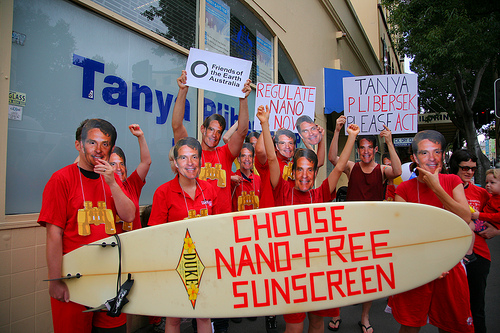
Nanotechnology – commonly defined as the ability to work with and build structures on a molecular level – is being adopted quickly in the cosmetics industry, especially in sunscreen products.
Zinc oxide and titanium oxide have widely been used to filter UV rays, but they leave behind a white residue. Nanotechnology has made it possible to crush them into smaller and smaller particles, until they become invisible and more efficient at absorbing UV rays.
With particles sizing up at just 1/100,000 the width of a strand of hair, concerns about potential toxicity issues have been raised. Some groups, like Friends of the Earth, claim that the chemicals could penetrate the dermal (lower) layer of skin and potentially have negative side effects.
But studies that test for these claims are showing nothing of the sort, says Perry Romanowski, cosmetic chemist and vice president at Brains Publishing. He says “we just aren’t seeing” evidence that the particles are reaching the dermal layer of skin. Rather, the particles are remaining in the epidermal (upper) layer.
According to Romanowski, nanotechnology is criticized partly because many of the studies out there are sponsored by the cosmetics industry, leading to assumptions that any information that is not flattering is subsequently not published. He says that if research were to show negative effects, companies would “abandon the technology altogether and try something else because nobody likes bad press about their cosmetics.”
“People are afraid of technology and they are afraid of chemicals,” Romanowski says. “A lot of times when people think something might happen, they assume that it does happen, even if it doesn’t.”
Because of its newness, the technology is still being developed and is not yet widespread throughout the industry, Romanowski says. The technology came about in the 1980s, so studies are still being done to determine the scope of its potential effects and uses.
It is already known that when particles are shrunk, their chemical properties change. But each molecule is different, and with the wide variety of particle out there, there is still a lot to be studied, says Saad Hasan, postdoctoral trainee at the University of Pittsburgh.
“The one thing [my colleagues and I] have learned is that we definitely can’t generalize about nanoparticles since their behavior in cell culture or mice depends on their composition, how they’re prepared and dispersed, what surfactant is used to aid their dispersion and even what cell or tissue they’re being investigated in,” Hasan says.
There currently are no U.S. Food and Drug Administration bans or regulations of nanotechnology, but a task force was created in 2006 to determine rules for its use and to research and evaluate possible health risks.
There is a stricter movement afoot in Europe, though. According to the European Commission, “Where the full extent of a risk is unknown, but concerns are so high that risk management measures are considered necessary, as is currently the case for nanomaterials, measures must be based on the precautionary principle.”
On the one hand, Romanowski says it is wise to “proceed with caution” because there is still a lot that is unknown about the effects nanotechnology can have on a person’s well-being. But on the other, he says it is a promising prospect.
“It’s pretty cool,” says Romanowski. “It certainly is an area of innovation that cosmetic chemists could exploit, so it could lead to cosmetics that work better than the stuff we have right now. Don’t be automatically afraid of something just because you don’t understand it.”
Related articles
- Nanotechnology: Will it kill us all? | Pakalert Press (pakalertpress.com)
