
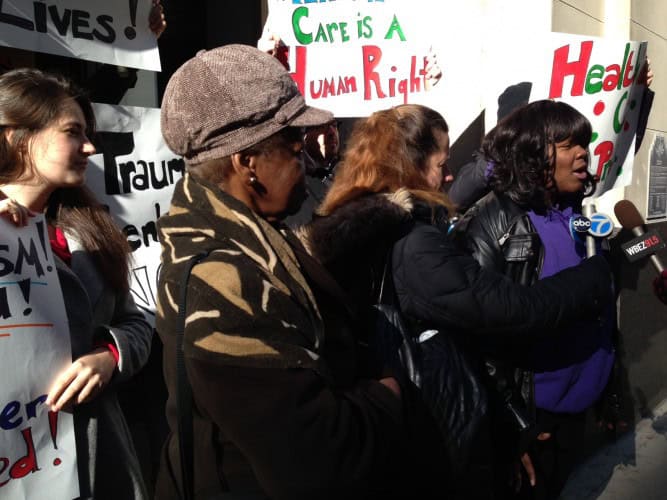

Two Illinois lawmakers on Wednesday called for more trauma centers on Chicago’s South and West Sides, saying a key new study shows that if ambulance rides are more than five miles away, victims are more likely to die.
“No one should die because of their zip codes,” said state Rep. Mary Flowers (D-Chicago). She attended a special subcommittee hearing of the Illinois Senate Public Health Committee held in downtown Chicago.
Racial discrimination and preconceived notions about impoverished blacks have lead to the “trauma center desert” in certain parts of the city, Flowers said.[pullquote] See our related feature: How do Trauma Deserts affect young people?[/pullquote]
State Sen. Mattie Hunter, chair of the subcommittee on special issues, said the city should have addressed the needs of the communities a long time ago.
A recent study at the Finberg School of Medicine at Northwestern University showed that of 11,744 gunshot wound patient, 4,782 were shot more than five miles from a trauma center. The average transport time and unadjusted mortality were higher for these patients. Victims suffering from gunshot wounds for more than five miles from a trauma center were associated with an increased risk of death.
“Trauma centers that are easily accessible ultimately help save more lives,” said Dr. Marie L. Crandall of the Feinberg School, who works closely with trauma patients.
The city currently has six trauma centers. Trauma centers are highly specialized medical facilities equipped with the resources and staff needed to treat life-threatening injuries. Without a trauma center in close proximity to the victim, they have a greater chance of dying.
Trauma centers are categorized in two ways. Level I centers have 24-hour, on-site trauma surgeons and the appropriate medicine needed to treat the patients. Level II centers have the medicines available with fewer trauma surgeons on the premises.
“My friend was shot right under the 47th Street Green Line train station and was taken across town to Stroger Hospital as opposed to one that was closer, and died because of it,” said Michael Dunn, a 19-year-old Harold Washington College student.
Veronica Moore has lived on the South Side for more than 21 years and has seen an increase in violence within her community. Morris said the lack of trauma centers on the city’s South Side reflects discrimination and social injustice.
“This is a direct attack on poor people,” said Moore, who is a member of Fearless Leading by the Youth, an advocacy group that is pushing for more trauma facilities in undeserved areas of the city.
Crandall and her associates at Northwestern said the study’s findings show that there is a great need for the centers.
“The study doesn’t negate the costliness of the centers, which could be between $5 – $40 million,” she said. “Approximately seven to eight more lives would be saved if trauma centers proximity didn’t exceed five miles.”
However, the need for trauma centers within close range to individuals most susceptible to traumatic incidents is very high.
Flowers equated the need for trauma centers in the most violent areas of the South Side to those in battlefields used by military personnel.
“When soldiers are in the battlefield, they have trauma centers in the trenches,” said Flowers. “That’s why our troops are able to come home.”
Dr. Philip Verhoef, 38, is a physician at the University of Chicago Intensive Care Unit and said everyone deserves that level of care. He has held this position for four and a half years. He works in the adult and pediatric intensive care units.
He said this is not only a gun violence issue, but also a public health issue. [pullquote]“If the patient is more than five miles from a trauma center, they are 21 percent more likely to die,” Verhoef said.[/pullquote]
Sheila Headspeth, Sydney Lawson, Ke’yanna Johnson and Jasmine Browley contributed to this story.
